Atoms · light · sound
The emission lines of hydrogen to uranium, brought down forty octaves to the ear. A line is a frequency of light; divided by 2⁴⁰ it is a note, and the lines of an element sound together as the chord they are. Atom Spectrum plays that chord and takes it apart: which notes, which intervals, how rough, what pitch the ear settles on, and which levels each line fell between.
· Sound starts with your first click or key: a browser waits for you to do something
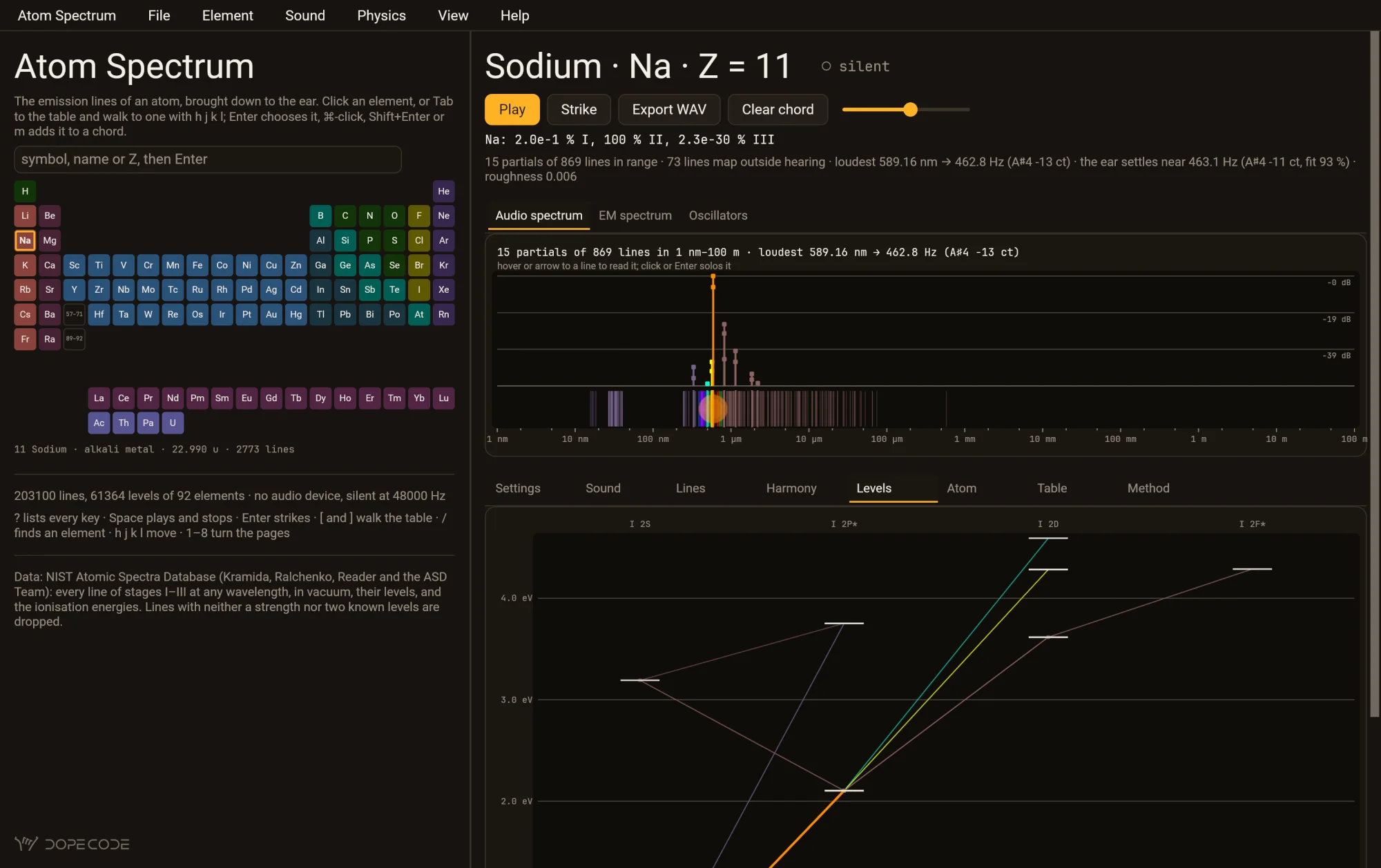
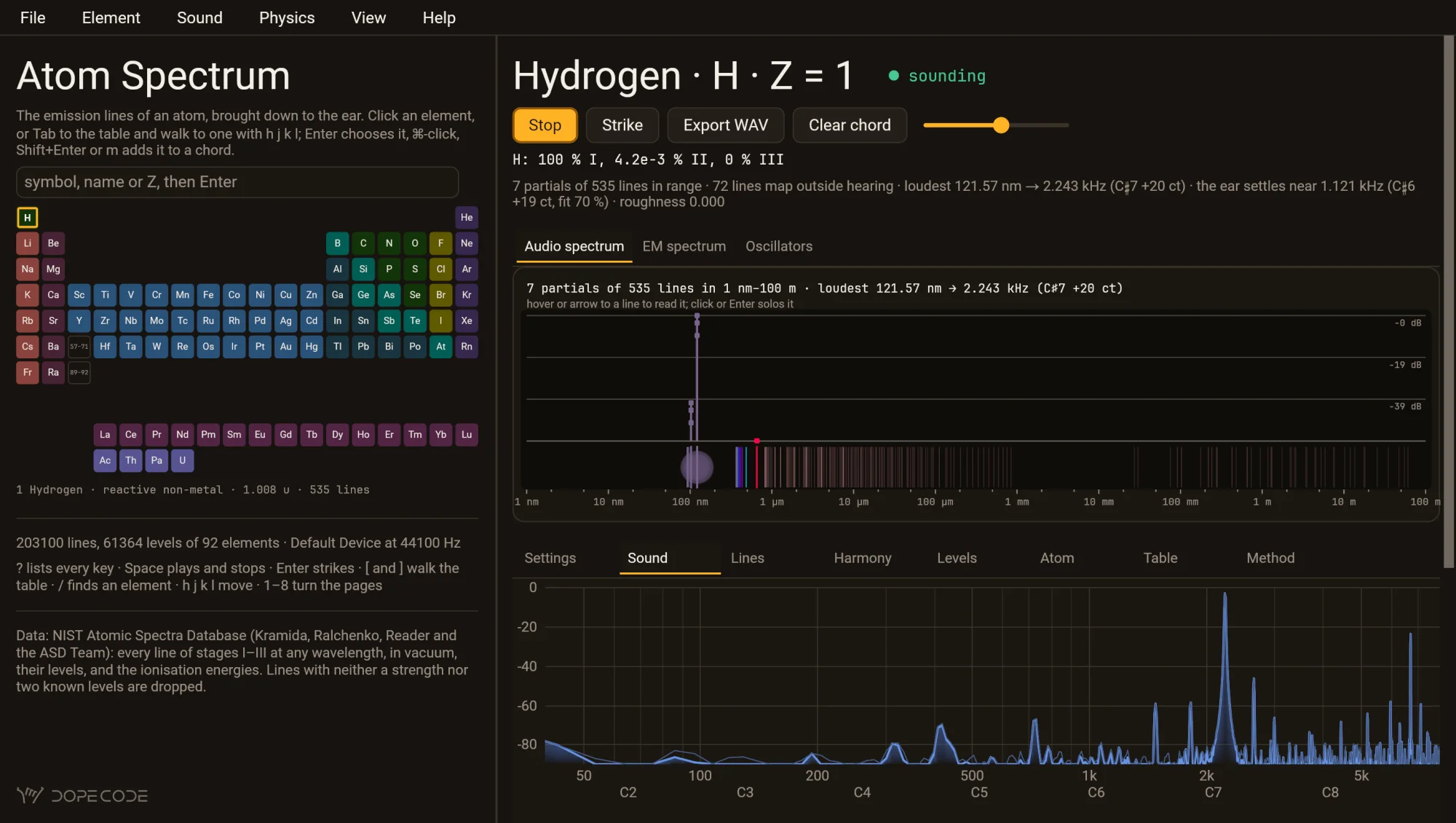
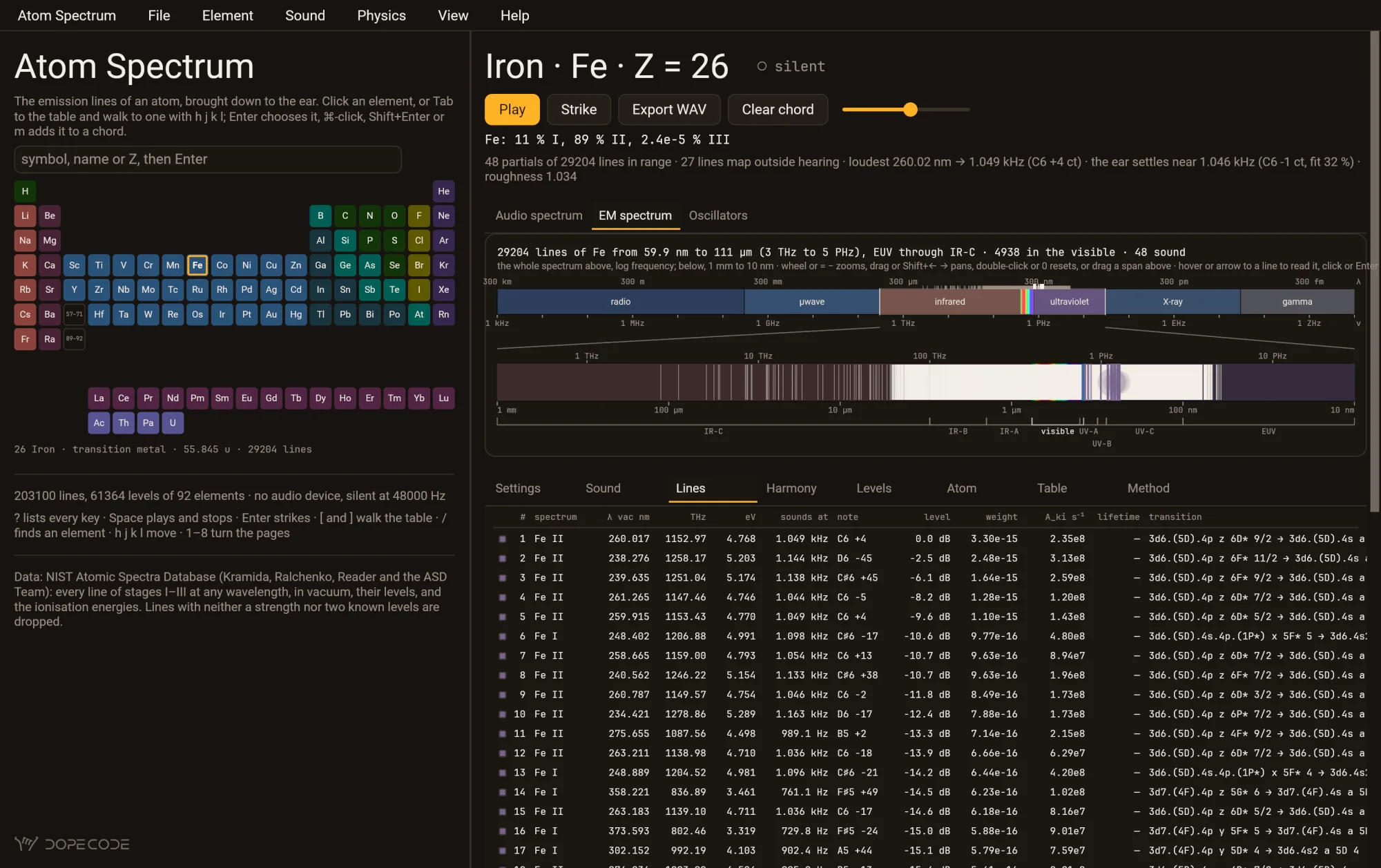
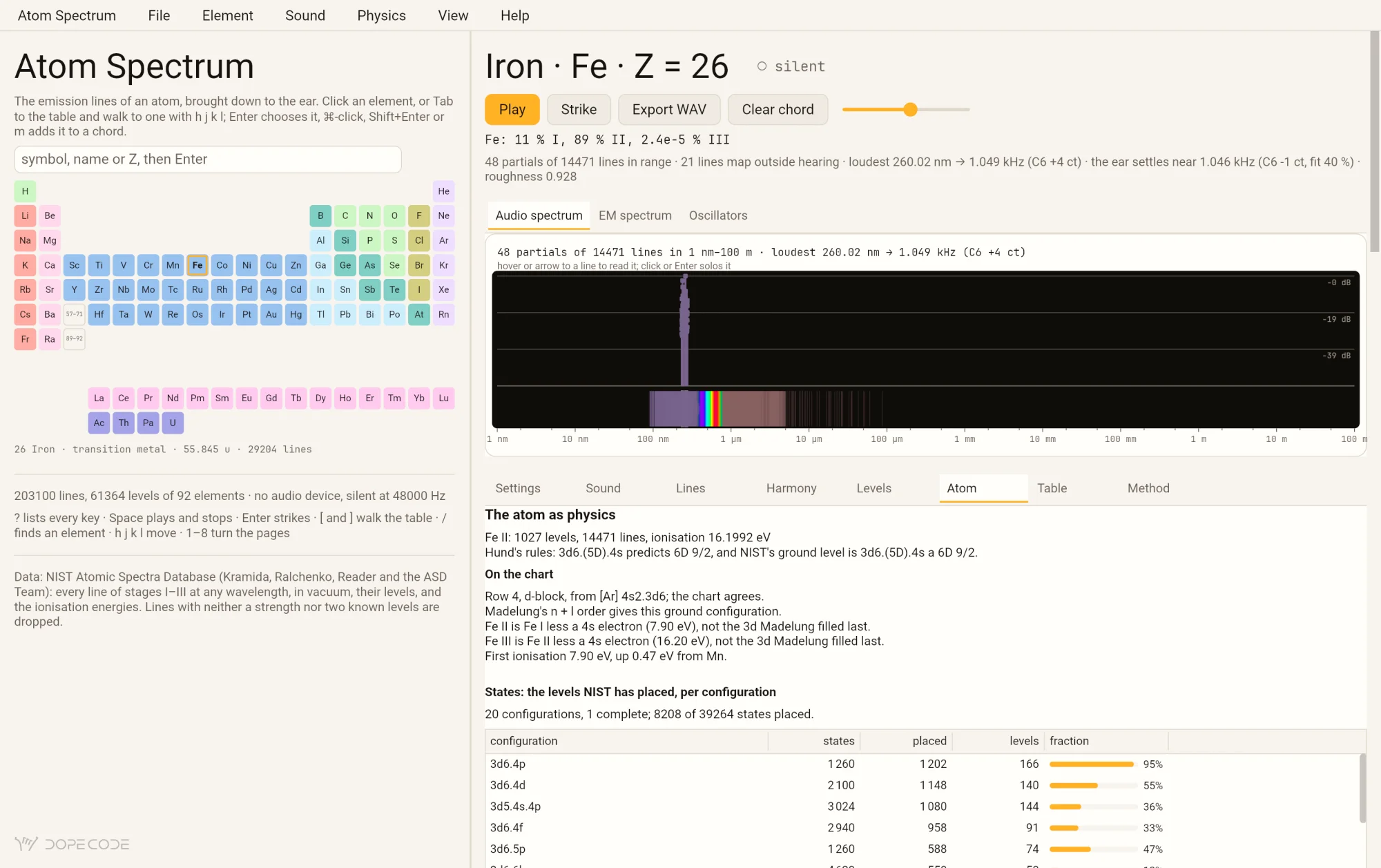
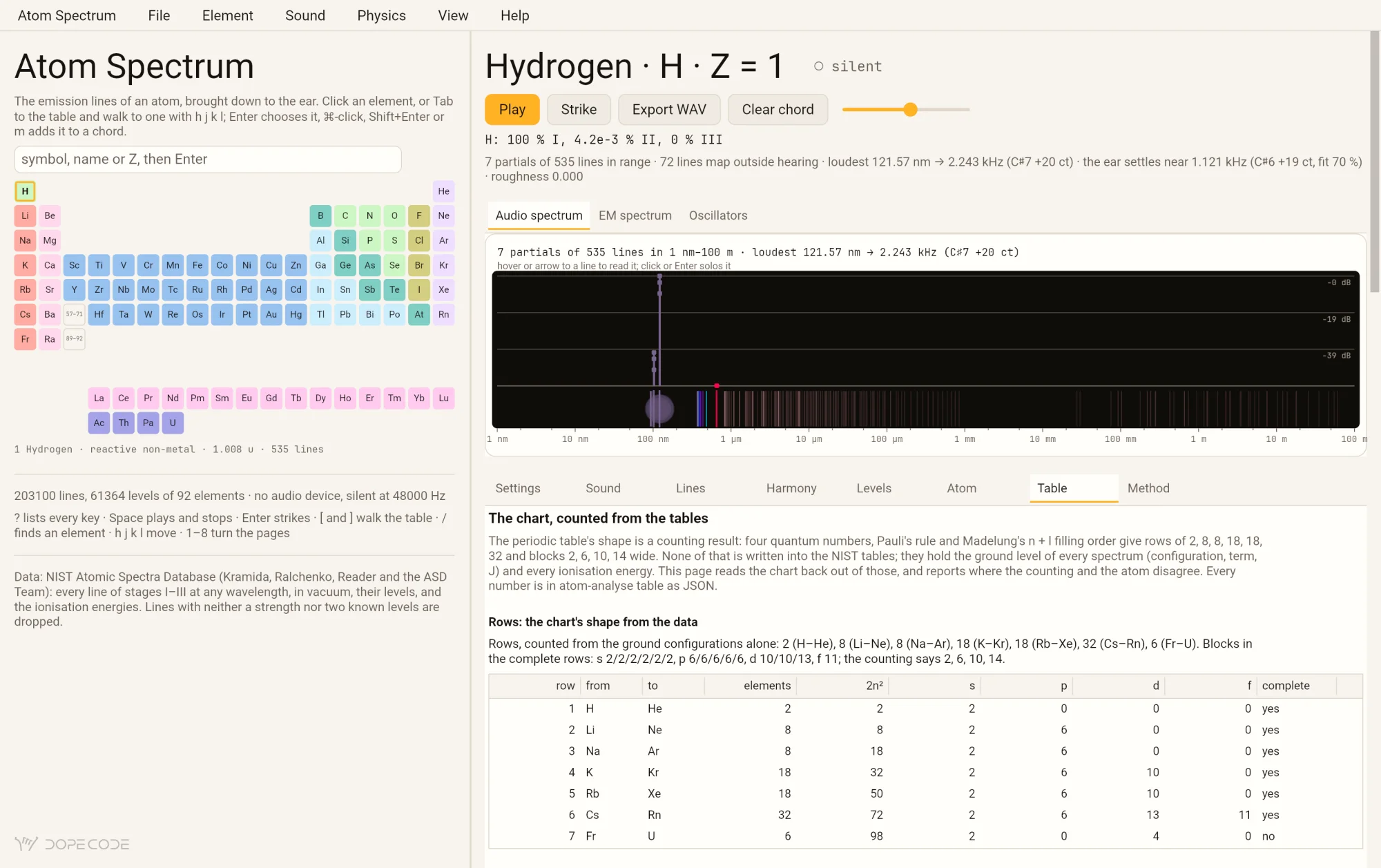
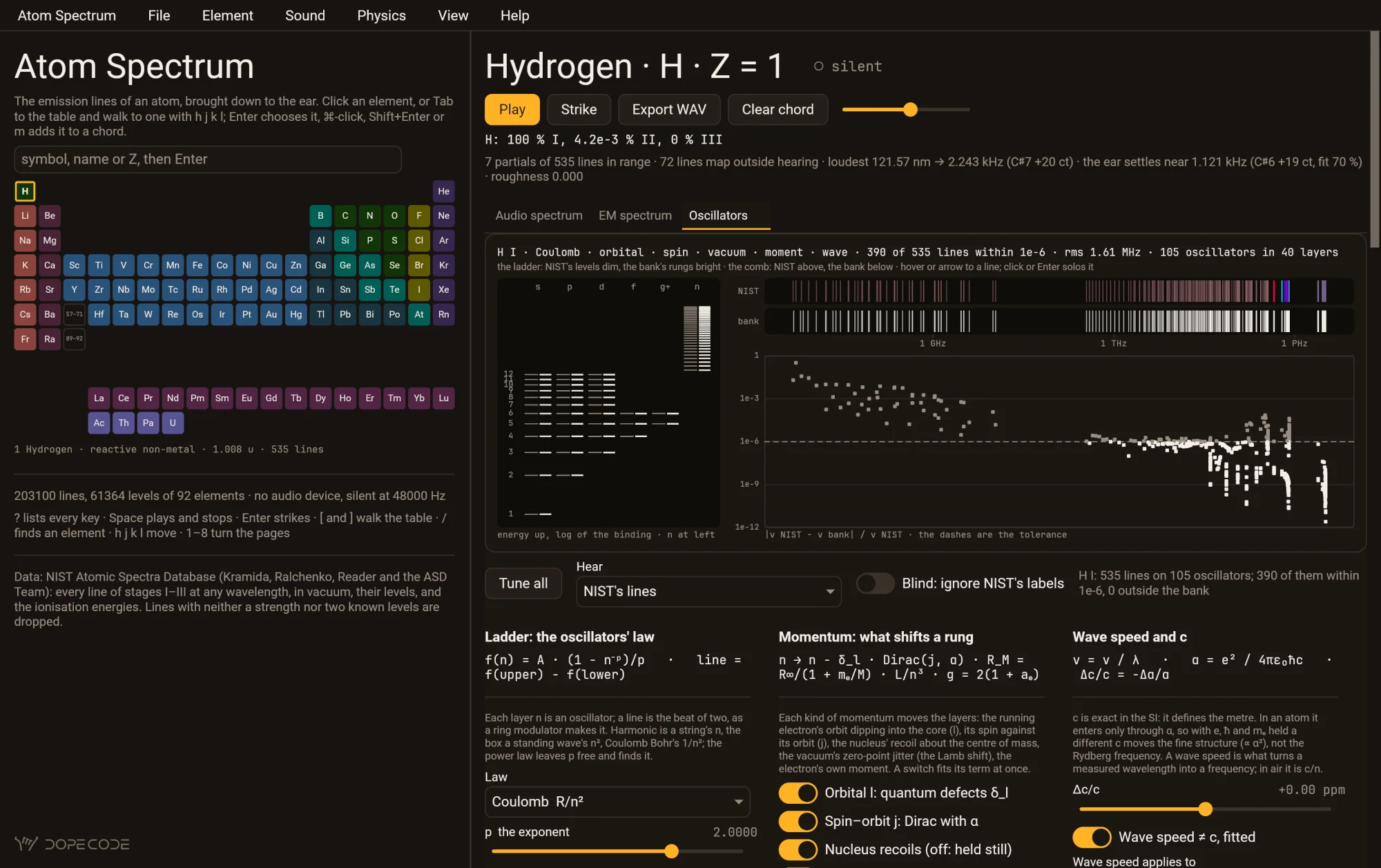
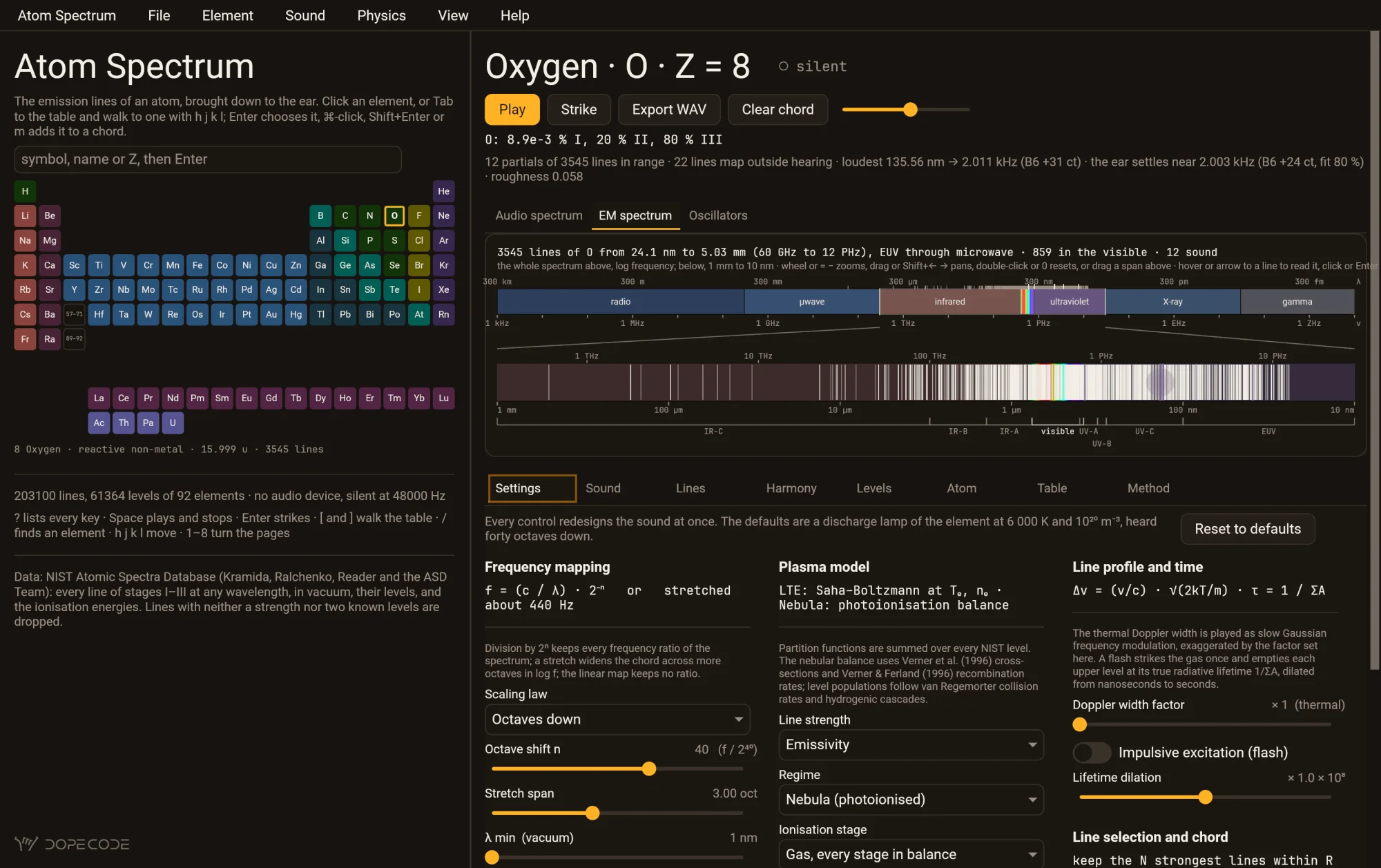
Every picture on this page is Atom Spectrum drawing its own window — headless, through its own test agent, at twice its size — or running in a browser tab. Every line in them is one the NIST Atomic Spectra Database lists, with its wavelength, its transition probability and the two levels it runs between. Nothing is drawn for effect.
Stages I to III of 92 elements, 203 100 lines and 61 364 levels, are packed into the program itself, so once it is open it needs no connection.
Hear it
Dividing every frequency by the same power of two keeps every interval between them. The visible octave, 384 to 789 THz, lands at 350 to 720 Hz; the ear's ten octaves take in 13.6 µm to 13.6 nm. A line that lands outside hearing is counted in the status line, not played, and never quietly folded back in.
g·A, the Boltzmann factor, and the partition function summed over every level NIST lists. Or NIST's own intensities, g·A, or every line alike.⌘- or Ctrl-click, Shift+Enter or m adds an element, balanced by equal numbers of atoms or by the Sun's photospheric abundances.
/app/?H
Sodium's levelsThe D line at 589 nm, 462.8 Hz, and the levels it falls between/app/?Na+I&tab=levels
Iron's harmony48 partials of 29 204 lines: intervals, roughness, the pitch the ear hears/app/?Fe&tab=harmony
Iron as lightThe same lines on the whole electromagnetic spectrum/app/?Fe&tab=em
Hydrogen's oscillators535 lines as the beats of 105 oscillators in 40 layers/app/?H&tab=oscillators
The periodic tableRead back out of the tables: rows, blocks, Madelung's order/app/?tab=table
The page's query is the program's
command line: an element by symbol, name or number, a stage, and tab= a page
(settings, sound, lines, harmony, levels, atom, table, method) or a view of the spectrum
(audio, em, oscillators).
See it
The spectrum has three views. The audio spectrum is what you hear. The EM spectrum is the same lines on the whole electromagnetic spectrum, nineteen decades of frequency from radio to gamma, with the optical window under it from 10 nm to 1 mm in its ISO 21348 bands.
A and NIST's accuracy grade of it — and then where it sounds.c / λ is the line's frequency and the chord is exact.= - and H L, or drag a span above.The atom
The Atom page is the other analysis: of the atom rather than the sound. Each line of its summary opens the table it was made from, sortable by any column and following the element.
g factors against LS coupling; hydrogen, He II and Li III against the Dirac equation with the reduced mass and recoil, whose residual is the Lamb shift.
n + l order against every ground configuration: seventeen atoms break it, chromium to uranium.s electron, not the d Madelung filled last.
Oscillators
A level is an oscillator at E/h and a line is
the beat of two, as a ring modulator makes it: hydrogen's 535 lines need 105 oscillators in 40
layers. The third view of the spectrum fits that bank without assuming the answer.
n, a box's n², a power law with its exponent free, or Coulomb's 1/n².α, the nucleus' recoil, the vacuum's Lamb shift, the electron's own moment.p/q) and sidebands (a hidden oscillator at F would put lines at ν ± F).Two gases
The default gas is a lamp of the element at 6000 K and
10²⁰ electrons per m³, in local thermodynamic equilibrium. Press t and it is an
H II region or a planetary nebula instead: a thousand electrons per cm³, lit by a star, where
nothing is in equilibrium.
Keys
Vim's motions, dired's marks and readline in the element field. The control that has the keyboard hears a key first, so a plain letter is safe: the periodic table walks its cells, a slider keeps its arrows.
Enter strikes? lists what is active, and on the desktop a [keybindings] table in config.toml replaces the defaults per action.g G to the ends, Ctrl+u Ctrl+d ten rows at a time, Enter to choose or to solo a line.Ctrl+a Ctrl+e, Alt+b Alt+f, Ctrl+k Ctrl+u Ctrl+w.F2 switches.Where the numbers come from
Nothing measured about an atom is exact. What can be exact is the bookkeeping: every number carries its source and its uncertainty, and every result is reported against the measurement it is compared with.
Lines with neither a strength nor two known levels are dropped. Atom Spectrum is not affiliated with NIST.
Privacy, itemised
The specific version, phrased so that you could go and verify it. The formal version is DopeCode's privacy policy.
Atom Spectrum <version> as its
producer, and nothing about you or your machine.The honest part
Better read here than found out afterwards.
atom-analyse's, not the window's.Sound waits for you. A page may not make a sound before you have done something on it, so the sound starts with your first click or key.
The sound is made on the page's own thread, beside the drawing, so on a slow machine or in a busy tab a dense chord can stutter where the desktop window would not.
The keys are the defaults: the config.toml that rebinds them is the
desktop's. Export WAV is a download.
Help
Click anywhere on the page or press a key first: browsers wait for you to do something
before a page may play. Then Play (Space); the status beside the
element's name says sounding. If it does and you hear nothing, check that the tab
is not muted.
By default a line is as loud as the gas radiates it, and in most atoms a handful of lines carry nearly all of it; others land outside hearing forty octaves down. The status line counts both. Under Settings, Stretched spreads the lines over the octaves you choose, and a line strength of Flat makes every line alike.
Yes: the page's query is the command line. /app/?Fe+II&tab=lines opens
iron's first ion on the table of lines; an element can be a symbol, a name or an atomic
number, and tab= any page or view.
It is the same program as the desktop window, built for WebAssembly: every page, every view, every key. It needs WebAssembly and WebGPU or WebGL2, which current browsers have, and about 11 MB the first time.
Export WAV (E) renders four seconds of the chord — six with the flash
— as a stereo WAV, which the browser downloads.
Still stuck? Write to hello@dopecode.com with your Atom Spectrum version (Help ▸ About) and what it said.
In your browser
Atom Spectrum opens on hydrogen. Press Play, then ] for the next element, and
hear the periodic table one atom at a time.
· Questions first? Help answers the common ones.